Kanto Lampo Waterfall, Bali

We tell every guest the same thing before Kanto Lampo Waterfall: come for the rock, not the swim. Water runs down a wide, tiered black rock face into a pool that stays ankle to knee deep, which is exactly what makes the ledges here the most photographed spot near Ubud. This guide covers the fee, the hours, the short walk down, the photo-queue and tipping culture locals run at the base, and how Kanto Lampo stacks up against Tegenungan, Tukad Cepung and Tibumana. For the days when you would rather not ride out yourself, we line up the Kanto Lampo tours with a driver on the main page.
Quick answer
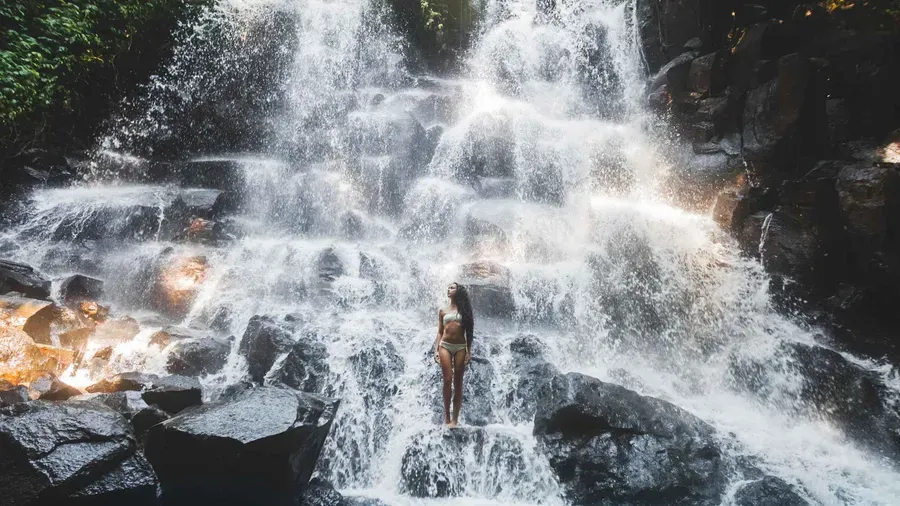
Kanto Lampo Waterfall is a wide, tiered rock-face cascade about 15 metres high in Beng village, Gianyar Regency, roughly 30 minutes by car from central Ubud. Entry costs IDR 25,000 in cash, and the site opens 6:30 AM to 5:30 PM daily. A paved path with stairs leads down from the parking area in about 5 to 10 minutes, and most visitors spend 45 minutes to 1 hour at the falls, mostly queueing for the signature rock-ledge photo.
Key takeaways
- Entrance fee IDR 25,000 cash per person; parking runs free to a small fee, up to about IDR 5,000
- Hours: 6:30 AM to 5:30 PM daily
- About 30-minute drive from central Ubud, in Beng village, Gianyar Regency
- Paved path with stairs, 5 to 10 minutes down; easy walk, no real hike
- Wading only, ankle to knee deep, not a real swim spot
- Locals help pose visitors on the rock ledges for the classic photo and expect a tip
- Come for the tiered rock, not the swim. Tours that stop at Kanto Lampo are listed below.
Guided Days from Ubud That Include Kanto Lampo
Kanto Lampo is reachable on your own by scooter or driver, so a guided tour here is about the driver and the multi-stop day rather than access to the falls. These tours pair Kanto Lampo with the Monkey Forest, the jungle swing, Ubud Palace, or the wider Ubud waterfall circuit, with pickup and the entrance fee handled for you.
 from $29
 Ubud: Spectacular Waterfalls Tour
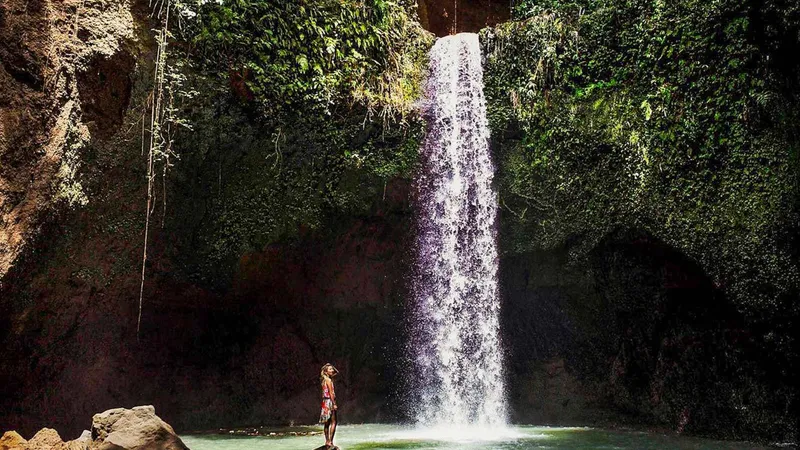
One day, three of the waterfalls people actually come to Ubud for: Tibumana, Tukad Cepung and Kanto Lampo. A driver-guide handles the roads between them, so the day…
- Tukad Cepung, where the light drops into the cave through a gap in the rock
- Tibumana, a single curtain fall with a pool calm enough to swim in
- Kanto Lampo, the tiered cascade that runs straight down the rock face
- Air-conditioned car and pickup from the Ubud area
 from $23
 Ubud: Waterfalls, Water Temple & Rice Terraces Private Tour
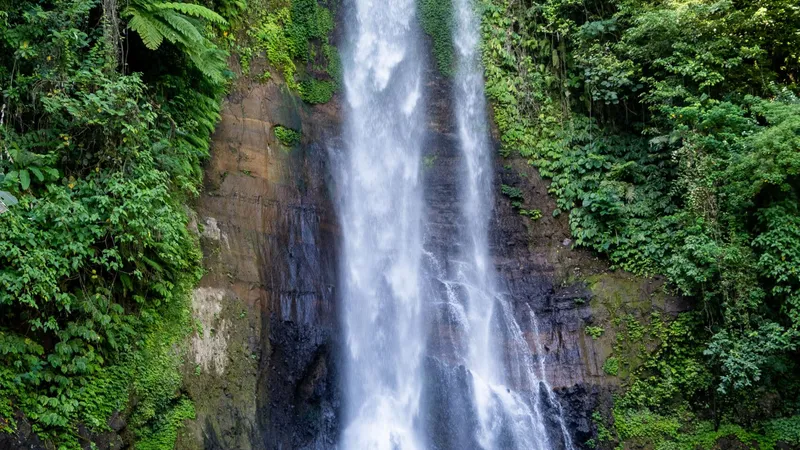
A private Ubud day built around three landmarks: a jungle waterfall, the holy spring temple of Tirta Empul, and the Tegalalang rice terraces. You choose a six-hour run…
- Tegalalang rice terraces, the tiered valley Ubud is known for
- Tirta Empul — the holy spring temple where Balinese still come to bathe
- Ubud waterfall stop with swimming time
- Private car and driver-guide; six-hour or full-day option
 from $27
 Bali/Ubud: Kanto Lampo Waterfall, Monkey Forest & Swing Tour
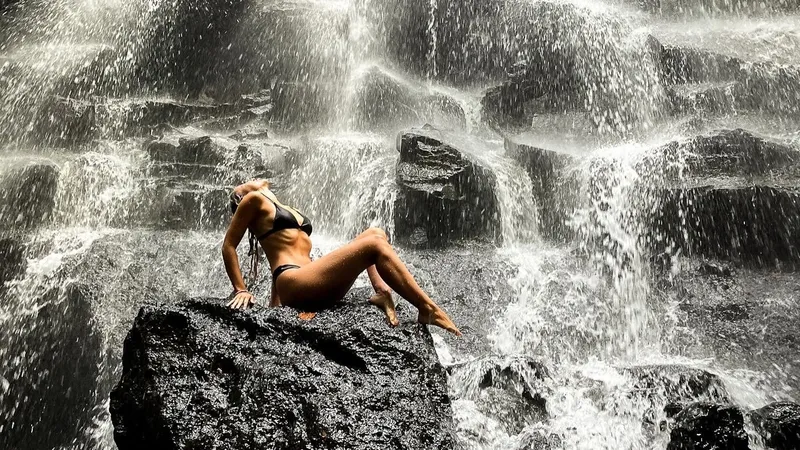
Chase the most photogenic waterfall in Bali — the tiered curtain of Kanto Lampo — then swing above the jungle canopy before exploring the Sacred Monkey Forest. A…
- Kanto Lampo Waterfall — Bali's most photogenic tiered cascade
- Iconic jungle swing with waterfall backdrop
- Sacred Monkey Forest — 700+ long-tailed macaques
- Tegalalang Rice Terrace viewpoint
 from $18
 Bali: Ubud Rice Terraces, Temples, and Waterfalls Tour
See three of Ubud's most celebrated landscapes in one day — the UNESCO-listed Tegalalang Rice Terrace, the sacred Tirta Empul Temple, and the thundering Tegenungan Waterfall. An expert…
- Tegalalang Rice Terrace — UNESCO Cultural Landscape
- Tirta Empul holy spring temple and purification pools
- Tegenungan Waterfall — swim at the base
- Expert local Balinese guide throughout
Kanto Lampo Waterfall: What It Is and Where It Sits
What Kanto Lampo Waterfall Is and Why People Go
Kanto Lampo is a wide, tiered rock face, roughly 15 metres high, where the river spreads and steps down black volcanic stone in a series of shelves before pooling shallowly at the base. It is not a single curtain fall and not a cave, the two shapes the other big waterfalls near Ubud take, which is part of why it reads so differently in photos. The rock ledges themselves are the draw: visitors climb partway up the tiers and pose with the water sheeting past them, a shot that has made Kanto Lampo one of the most photographed waterfalls in Bali, well beyond what its modest height alone would suggest.
The setting is tighter than Tegenungan's open amphitheater, jungle walls closing in on both sides of the river, which puts the sound of the water right on top of you as you come down the path and keeps the whole site compact enough to see in under an hour.
Kanto Lampo Waterfall Quick Facts
Last verified: August 2026. Two figures below carry a source conflict, parking and lockers, noted honestly rather than rounded to a single number.
| Detail | Kanto Lampo Waterfall |
|---|---|
| Entrance fee | IDR 25,000 per person, cash only |
| Parking | Free to a small fee, roughly up to IDR 5,000 |
| Hours | 6:30 AM to 5:30 PM, daily |
| Height | About 15 metres (roughly 50 feet) |
| Walk from parking | About 5 to 10 minutes, paved with stairs |
| Time at the falls | About 45 minutes to 1 hour |
| Locker rental | Small fee, roughly IDR 5,000 to 10,000 |
| Drive from Ubud | About 30 minutes |
| Address | Jl. Kaliasem, Lingk. Kelod Kangin, Beng, Gianyar |
Getting to Kanto Lampo Waterfall
From Ubud
From central Ubud, Kanto Lampo runs about a 30-minute drive, whether by private driver, self-drive scooter, or a Grab or Gojek ride booked from your hotel. The road east toward Gianyar narrows in places and threads through a couple of village centers, so a driver who already knows the turns saves real time over following a map app blind. This is not a walk-up stop from a main road: it sits down a residential lane, and a driver or a GPS pin saves you from missing the turn.
From Seminyak, Kuta and Canggu
From Seminyak, Canggu or Kuta the route runs longer than the Ubud drive, since it adds south Bali's traffic on top of the leg out to Gianyar. Treat any south-Bali estimate as a rough one and build in extra time rather than cutting it close, since detailed timing from those areas is thin across the guides that cover this route; a driver who has made the run before is worth more here than a map app's estimate.
From Sanur
No source gives a specific drive time from Sanur. The route runs a similar direction to the Seminyak and Kuta drives once it clears Denpasar and turns toward Gianyar, so treat this as an estimate somewhat shorter than the Seminyak figure and confirm with your driver before committing to a tight schedule.
From Ngurah Rai Airport
The airport sits on the opposite side of Denpasar from Kanto Lampo, so a direct taxi or ride-hail from arrivals adds the full width of the city to the Ubud-area drive time, an estimate rather than a sourced figure. Most visitors see Kanto Lampo later in their trip once they're based in or near Ubud, which avoids the longer airport-to-Gianyar haul entirely.
Parking and Arrival
The parking area sits at the top of the paved path down to the falls, with room for cars and motorbikes, though reports differ on whether it's free or carries a small charge up to around IDR 5,000. Keep a little cash on hand for parking regardless of which figure applies on the day you visit, and expect the lot to fill faster than the walk down takes once tour groups arrive after mid-morning.
Entrance Fee and What the Money Buys
Entrance Fee, Opening Hours and Address
Entry costs IDR 25,000 per person, cash only at the gate. The site opens 6:30 AM and closes 5:30 PM daily. The address is Jl.
Kaliasem, Lingk. Kelod Kangin, Beng, Kecamatan Gianyar, Kabupaten Gianyar, Bali, in the village of Beng within Gianyar Regency. Last verified: August 2026.
What the Fee Covers and What It Doesn't
The IDR 25,000 gate fee covers access to the site and the paved path down to the falls. It doesn't cover parking, which reports put anywhere from free to about IDR 5,000, a locker if you want a secure spot for your bag, or the tip most visitors pay the local photo helpers who pose them on the ledges, generally a minimum of around 25,000 to 30,000 IDR. Add those together and the realistic cost of a visit runs closer to IDR 55,000 to 65,000 per person once you factor in parking, a locker and a tip, rather than the headline gate fee alone.
Facilities at Kanto Lampo
The site has toilets, showers, changing rooms and lockers near the entrance, along with small stalls and a restaurant selling food and drinks. None of this is elaborate, closer to a set of simple riverside facilities than a resort-style amenity block, but it covers the basics for a visit of an hour or so. Rinse off at the showers before you change, since the walk back up the paved path is warm work even on a mild day, and grab a coconut or a plate of noodles at one of the stalls rather than waiting until you're back in Ubud.
Locker rental runs a small fee, reported at roughly IDR 5,000 to 10,000 depending on the source.
What to Pack
Bring a towel and a change of clothes, since the rock ledges and the base pool both leave you wet even without swimming. Sandals or flip-flops handle the wet stone better than closed shoes here, and a waterproof phone case is worth having if you plan to shoot from close to the falls. Carry cash in small rupiah notes for the entrance fee, tips for the local photo helpers, and the locker rental if you use one.
- Towel and a change of clothes
- Sandals or flip-flops with grip
- Waterproof phone case or dry bag
- Small rupiah notes for the fee, tips and lockers
The Walk Down and the Photo Queue, Minute by Minute
The Walk Down: Steps, Path and Difficulty
A paved pathway with stairs runs from the parking area down to the falls. One local guide clocks it at about 10 minutes, another puts the same walk at 5 to 7 minutes, so treat it as roughly 5 to 10 minutes depending on your pace and how many photo stops you make along the way. It is an easy to moderate walk, nothing close to a real hike, and no special fitness or hiking gear is needed beyond shoes with decent grip for the wet stone near the pool.
How Long People Stay
Most visitors spend about 45 minutes to 1 hour at the falls once they reach the bottom, which covers the walk down, the photo queue on the rock ledges, a short wade in the shallow pool, and the walk back up. Visitors who skip the ledge photo entirely and just wade and look move through faster, closer to 20 to 30 minutes total.
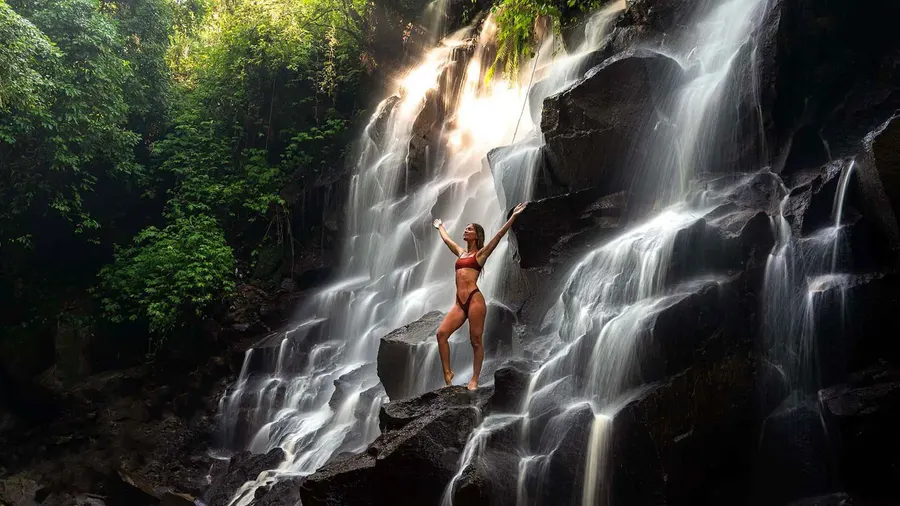
Photo Spots, Queueing and the Local-Helper Tipping Culture
Kanto Lampo is one of the most famous waterfalls in Bali, and the site runs on an almost assembly-line rhythm at busy hours: visitors queue at the base of the rock tiers, climb up one at a time for the signature shot, and step back down so the next person can take a turn. Local helpers work the ledges, positioning visitors and timing the shutter for the classic pose in the water, and they expect a tip for it, generally a minimum of around 25,000 to 30,000 IDR. Skipping the queue by climbing the rocks yourself is possible but slower and slicker than it looks; most visitors find the tip worth paying just for someone who knows exactly where to stand.
The queue forms right where the path meets the pool, and it moves fastest before 9 AM and slowest once tour groups converge between 10 AM and 1 PM.
Can You Swim at Kanto Lampo Waterfall?
Wading, Not Swimming
Only in the loosest sense. The pool at the base stays ankle to knee deep, with little room to swim and even less depth to do it in, so treat Kanto Lampo as a wading and photo stop rather than a swim spot. If a real swim is what you want on the same trip, Tibumana and Suwat waterfalls both offer deeper, calmer pools better suited to actually getting in the water.
Best Time to Visit: Hour by Hour
Opening, 6:30 to 9 AM
This is the window worth planning around. Arrive before 9:00 AM for the best light on the rock face and the shortest wait for the photo ledges, before the first tour groups of the day reach the parking area.
Mid-Morning, 9 to 10 AM
Crowds start to build steadily through this hour as independent visitors and the earliest small-group tours arrive. The queue for the ledges lengthens but is still manageable compared with what follows.
Midday, 10 AM to 1 PM
Peak crowds hit in this window, when tour groups converge on the site and the photo queue stretches longest. The light also flattens across the rock face by this point, so a late-morning arrival costs both the wait and the better photo, a bad trade twice over.
Afternoon
Crowds ease off after the midday peak as day-tour groups move on to their next stop, though Kanto Lampo rarely empties out completely the way some of the quieter waterfalls near Ubud do. Weekday mornings run noticeably calmer than weekend mornings overall, since Kanto Lampo pulls day-trippers from south Bali on top of the usual Ubud crowd once the week turns to Saturday.
Season and Water Conditions
What Changes with the Season
No source we found gives season-specific flow or water-clarity data for Kanto Lampo the way some guides do for Ubud's other waterfalls, so we won't invent a dry-versus-wet breakdown here that isn't backed by anything. What does carry over from the wider region: Bali's dry season runs roughly April to October and its rainy season November to March, and the same overnight-rain effect that raises flow and muddies rivers elsewhere nearby can plausibly do the same here. If you're visiting during or just after heavy rain, treat the rock ledges as more slippery than usual, and don't push a photo climb if the footing feels off.
A Realistic Visit to Kanto Lampo
From Parking Lot to Ledges
The sequence is short and repeats for almost every visitor: pay at the gate, walk the paved path down, join the queue at the pool, take a turn on the ledges, wade for a few minutes, then climb back. Most of the visit is spent waiting and posing rather than walking, which is the opposite of Tegenungan, where the walk and the swim take up more of the time than any queue.
A Sample Timeline
This is how an early arrival tends to break down. Arriving later shifts every step of this later and adds time to the queue rather than to the walk.
| Time | What's Happening |
|---|---|
| 6:30 AM | Arrive, pay the IDR 25,000 entrance fee and any parking charge |
| 6:35 AM | Walk down the paved path, 5 to 10 minutes |
| 6:45 AM | Short or no queue for the rock-ledge photo before the crowd builds |
| 7:00–7:30 AM | Wading, extra photos, tip the local helper |
| 7:30–7:40 AM | Walk back up to the parking area |
Kanto Lampo vs. Tegenungan, Tukad Cepung and Tibumana
How the Four Waterfalls Compare
Ubud's four main waterfalls split into distinct roles, and Kanto Lampo's is photography over swimming.
| Waterfall | Character | Best For |
|---|---|---|
| Kanto Lampo | Tiered rock-step cascade, shallow pool | The rock-ledge photo, wading |
| Tegenungan | Biggest, busiest, wide curtain fall | Real swimming, closest to south Bali |
| Tukad Cepung | Cave waterfall with a light-beam shaft | The single most dramatic sight of the four |
| Tibumana | Calmer single curtain into a swim pool | A quieter, actually-swimmable alternative |
Which Waterfalls Pair Well with Kanto Lampo
Kanto Lampo sits about 30 minutes from Tegenungan, which makes a Kanto-Lampo-then-Tegenungan morning a realistic sequence: the photo stop first while the ledges are still quiet, the swim second once the sun is higher and a dip sounds better than another queue. Tukad Cepung and Tibumana sit closer to Tegenungan than to Kanto Lampo, so folding all four waterfalls into one day usually means less time at each stop and a rushed finish. If seeing all four matters more than a relaxed pace, treat Kanto Lampo as the outlier and pair it with Ubud's cultural sites instead, saving the three-waterfall Tegenungan, Tibumana and Tukad Cepung route for a separate day.
Visiting Independently or With a Guide
Visiting Independently vs. With a Guide
The path to Kanto Lampo is short, paved and clearly marked, so no guide is required for the walk itself; a self-drive scooter, a private car with driver, or a Grab or Gojek booking all get you to the parking area without trouble. Where a guide earns its keep is the day around it: our pick of Ubud waterfall tours pairs Kanto Lampo with the Monkey Forest and the jungle swing, or with Ubud Palace and the Art Market, so the 30-minute drive out here becomes one stop in a fuller day rather than a there-and-back trip on its own. The Kanto Lampo, Monkey Forest and swing tour and the Kanto Lampo, Ubud Palace and Art Market tour both build a half day around exactly that.
Is Kanto Lampo Waterfall Worth Visiting?
Yes, with the right expectation going in. It is not a swim stop, and it is not quiet, so anyone hoping for a private jungle pool should look at Tibumana instead. What Kanto Lampo delivers is one of the strongest photo spots near Ubud, a striking tiered rock face that photographs better than almost anywhere else in the area, and it earns its spot on nearly every multi-waterfall itinerary for exactly that reason.
Where Is Kanto Lampo Waterfall?
Kanto Lampo Waterfall sits at Jl. Kaliasem, Lingk. Kelod Kangin, Beng, Gianyar Regency, about 30 minutes by car from central Ubud.
Kanto Lampo Waterfall: Frequently Asked Questions
Is Kanto Lampo Waterfall worth visiting?
Yes, for the photo more than the swim. Kanto Lampo's tiered rock face is one of the most photographed spots near Ubud, though the shallow pool means it is not the place to go if a real swim is what you want.
How much time should you spend at Kanto Lampo Waterfall?
Most visitors spend about 45 minutes to 1 hour at the falls, which covers the walk down, the photo queue on the rock ledges, and a short wade in the shallow pool before heading back up.
Are there any risks at Kanto Lampo Waterfall?
The main hazard is slippery wet rock around the pool and on the ledges people climb for photos, so wear sandals with real grip and go barefoot only where locals guide you. The crowded queue at peak hours is more of an annoyance than a danger, but rushing on the wet stone to beat the line is where most slips happen.
Which is the most beautiful waterfall in Bali?
It depends what you value most. Kanto Lampo wins on photogenic rock texture, Tukad Cepung on cave drama with its light-beam shaft, and Tegenungan on scale and swimming. Among Ubud's four main waterfalls, Kanto Lampo is the one that shows up most often in Bali travel photos.
Do you have to hike to Kanto Lampo Waterfall?
No. A paved path with stairs runs from the parking area to the falls, about 5 to 10 minutes each way, an easy walk rather than a hike.
Is Kanto Lampo free?
No. Entry costs IDR 25,000 per person, cash only, paid at the gate.
Is Kanto Lampo Waterfall wheelchair-friendly?
No. The path down includes stairs and uneven wet stone near the pool, which rules out wheelchairs and makes strollers impractical as well.
What are the opening hours of Kanto Lampo Waterfall?
The site opens 6:30 AM and closes 5:30 PM daily.
How is Kanto Lampo different from Tegenungan, Tibumana and Tukad Cepung waterfalls?
Kanto Lampo is a tiered rock-step cascade built for photos on the ledges, with only a shallow wading pool. Tegenungan is the biggest and busiest, with a real swimming pool, closest to south Bali. Tukad Cepung is the cave waterfall, with light beams dropping through a gap in the rock overhead. Tibumana is calmer and less crowded, a single curtain into a pool deep enough for an actual swim.
Kanto Lampo rewards patience with the crowd more than any special gear or planning. Show up early, be ready to wait a few minutes on the ledges even then, and treat the tip to the local photo helper as the price of the shot everyone comes here for. It is a five-minute stop that photographs like an hour's worth of Bali, and that trade is exactly why it stays on nearly every waterfall itinerary out of Ubud.