Tegenungan Waterfall, Bali

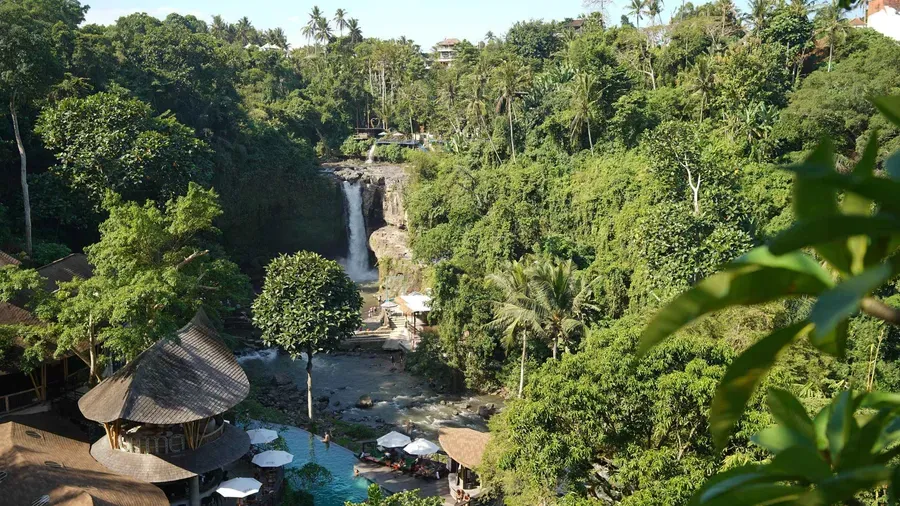
We send more guests to Tegenungan Waterfall than to any other cascade near Ubud, and it earns the trip: a wide curtain of white water dropping into a jungle pool large enough to swim laps in, a short paved walk from the parking lot on the Petanu River. Locals also call it Blangsinga Waterfall, same site, one name from each side of the valley. This guide covers the fee, the hours, the walk down, whether you should jump off the rocks, and how Tegenungan compares to Kanto Lampo, Tukad Cepung and Tibumana. If you would rather have the driving handled, we compare the Tegenungan waterfall tours running from Ubud on the main page.
Quick answer
Tegenungan Waterfall drops about 15 metres into a wide pool in Kemenuh village, Gianyar Regency, roughly 20 to 30 minutes by car from central Ubud. Entry costs IDR 20,000 in cash, parking is free, and the site opens 6:30 AM to 6:30 PM daily. About 150 to 170 stairs lead down through jungle to the base, a five-minute walk that takes longer coming back up the same stairs.
Key takeaways
- Entrance fee IDR 20,000 cash per person; parking is free for cars and motorbikes
- Hours: 6:30 AM to 6:30 PM daily
- Height about 15 metres, on the Petanu River in Kemenuh village, Gianyar Regency
- About 150 to 170 steps down, roughly 5 minutes each way but steeper on the climb back up
- Swimming is allowed in the buoyed base pool; skip the cliff jump, the water is not deep enough
- Also called Blangsinga Waterfall, the same waterfall under a second local name. For a quieter swim, compare Tibumana
- Closest of the four to the south of the island, and the busiest by mid-morning. Guided days that include Tegenungan start below.
Guided Days from Ubud That Include Tegenungan
Tegenungan is easy to reach on your own, so a guided tour here is about the driver and the rest of the day rather than access to the waterfall itself. These tours pair Tegenungan with temples, rice terraces or the Monkey Forest, with pickup and the entrance fee handled for you.
 from $25
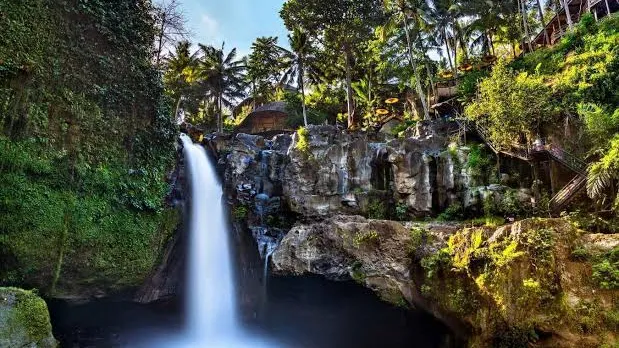
 Ubud: Waterfall, Rice Terraces & Monkey Forest Private Tour
Discover the spiritual center of Bali on a fully private Ubud tour. Visit Tirta Empul Temple for the sacred water ritual, wander the Sacred Monkey Forest, admire the…
- Fully private tour — your guide, your pace
- Tirta Empul Temple holy water purification ceremony
- Tegenungan Waterfall swim
- Tegalalang UNESCO rice terraces
 from $29
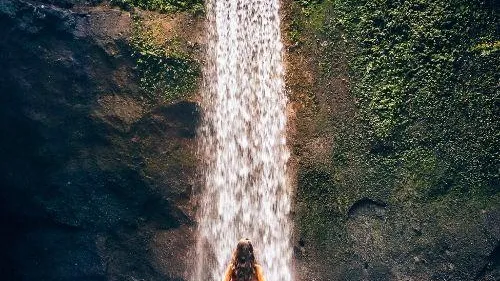
 Ubud: Private Scenic Waterfalls & Rice Terraces Tour
Experience Ubud's most stunning waterfalls — Tegenungan, Tibumana, and Tukad Cepung — plus the iconic Tegalalang Rice Terrace on a private guided tour. Discover Bali's most celebrated natural…
- Three waterfalls: Tegenungan, Tibumana & Tukad Cepung
- Tukad Cepung — the legendary cave waterfall with light beams
- Tegalalang Rice Terrace panoramic viewpoint
- Fully private — just you and your guide
 from $33
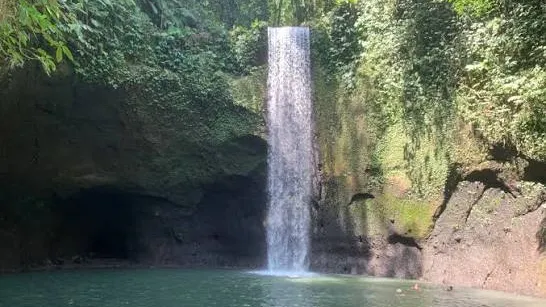
 Bali: Saraswati Temple & Ubud Monkey Forest with Waterfalls
Combine Ubud's cultural landmarks and natural beauty on one full-day tour. See the ornate Saraswati Water Temple, walk through the Sacred Monkey Forest Sanctuary, and cool off at…
- Saraswati Water Temple — lotus ponds & intricate stonework
- Sacred Monkey Forest Sanctuary with 700+ long-tailed macaques
- Tegenungan Waterfall swim stop
- Traditional Balinese village walk
Tegenungan Waterfall: What It Is and Where It Sits
What Tegenungan Waterfall Is
Tegenungan sits on the Petanu River, a waterway that runs about 47 kilometers from the Mount Batur highlands in Kintamani down through Tampaksiring, Ubud and Blahbatuh before reaching the sea. Unlike most of Bali's waterfalls, which sit in mountainous terrain, Tegenungan drops through lower farmland in Kemenuh village, Gianyar Regency, which is part of why it draws the biggest crowds near Ubud: cars and motorbikes reach the parking lot directly, with no highland drive required. The waterfall itself is wide rather than tall, a broad sheet of water crashing into a natural pool ringed by jungle, and it has become the default stop on almost every waterfall day trip that leaves Ubud.
Tegenungan Waterfall Quick Facts
Last verified: August 2026. Fees and hours below are what the gate charges as of this update; carry small rupiah notes since the ticket booth runs on cash.
| Detail | Tegenungan Waterfall |
|---|---|
| Entrance fee | IDR 20,000 per person, cash |
| Parking | Free, cars and motorbikes |
| Hours | 6:30 AM to 6:30 PM, daily |
| Height | About 15 metres |
| Stairs down | About 150 to 170 steps |
| Walk down | About 5 minutes; longer back up |
| Drive from Ubud | About 10 km, 20 to 30 minutes |
| Drive from Seminyak/Kuta/Canggu | About 1 hour |
| Also known as | Blangsinga Waterfall |
Tegenungan or Blangsinga? Same Waterfall, Two Names
Ask a driver for Blangsinga Waterfall and you will end up at Tegenungan. The two names refer to the same site, drawn from the villages on either bank of the Petanu River, and both show up on signage and maps around Kemenuh. If a tour or a map lists Blangsinga as a separate stop, check the coordinates before assuming it is a second waterfall to visit.
Getting to Tegenungan Waterfall
From Ubud
Tegenungan sits about 10 km from central Ubud, off the road toward Kemenuh and Blahbatuh. Sources differ on drive time: two local guides put it at about 20 minutes by car or motorbike in light traffic, while another puts the same route at about 30 minutes, likely a matter of when you're driving. Budget 20 to 30 minutes and expect the longer end during the midday rush on the roads out of Ubud.
The turnoff is signed from the main road, and the final stretch narrows through a village before opening into the parking area.
From Seminyak, Kuta and Canggu
From Seminyak or Kuta, plan on about 1 hour to reach Tegenungan by car, most of it spent clearing Denpasar's ring road before the route turns north toward Gianyar. From Canggu, the drive also runs about 1 hour, similar in length to the Seminyak route despite the extra distance on the map, since both funnel through the same stretch of traffic. Leaving by 6 AM from any of these three areas gets you to the falls close to the 6:30 AM opening; leave any later and expect to arrive well into the mid-morning crowd.
From Sanur
No source gives an exact drive time from Sanur specifically. The route runs in roughly the same direction as the Seminyak and Kuta drive, joining the same road north once it clears Denpasar, so treat it as an estimate of about 50 minutes to 1 hour and confirm with your driver before committing to a tight schedule.
From Ngurah Rai Airport
The airport sits on the far side of Denpasar from Tegenungan, so a taxi or ride-hail straight from arrivals runs closer to 1 hour to 1 hour 15 minutes depending on traffic through the city, longer again during the afternoon rush. Most visitors see Tegenungan later in their trip once they're based in Ubud or Gianyar rather than on the way in from a flight, which is the more practical order given the drive.
Parking and Arrival
The lot sits beside the entrance gate, a short walk from the ticket booth, with space for both cars and motorbikes. There's no reserved parking and no valet service, so during the site's busiest late-morning hours you may need to wait a few minutes or park further along the access road while a spot clears.
Entrance Fee and What the Money Buys
Entrance Fee, Tickets and What's Covered
Entry to Tegenungan Waterfall costs IDR 20,000 per person, paid in cash at the gate. There is no online ticket to buy in advance and no card reader at the booth, so bring rupiah. The fee covers access to the site and the stairway down to the pool; it does not cover the rope swing, food or drinks at either restaurant, or the money changer's rate if you need to exchange currency on site.
There's no bag-check counter, so most visitors either leave valuables in the car or keep bags within sight at the pool. Last verified: August 2026.
Parking, Changing Room and ATM
Parking is free at Tegenungan, for both cars and motorbikes, in the lot beside the entrance gate. A small changing room sits to the left of the entrance, useful if you plan to swim and would rather not walk back to the car in wet clothes. There is no ATM on site, but a money changer operates right before the ticket booth, so exchange what you need before you pay for entry.
The Rope Swing Fee
The rope swing above the pool is a separate charge from the entrance fee: about IDR 200,000, roughly 13 dollars, for a single swing. The operators generally work from around 9:00 AM to 6:00 PM, and since only one rider swings at a time, the line stretches longest during the midday crowd window, between about 11 AM and 2 PM.
What to Bring and Wear
A swimsuit under your clothes saves a trip to the changing room, and grippy sandals or water shoes handle the wet stairs better than flip-flops, especially in rainy season. Bring a dry bag or a waterproof phone case if you plan to shoot photos from the pool, and a small towel for the walk back up. Carry cash in small rupiah notes for the entrance fee, the swing, and the money changer if you need it, since none of these accept cards.
The Walk Down, Minute by Minute
Stairs, Surface and Handrails
The stair count gets reported differently depending on who is counting: one popular local source puts the total at 168, while a sign posted at the site itself gives roughly 127, and other guides land around 150 to 170. Rather than pick a number to sound precise, treat it as about 150 to 170 stairs, a fixed stone stairway rather than a dirt trail, wide enough for two people to pass in most sections. Handrails run along the steeper upper flights but stop for a stretch nearer the bottom, where the steps narrow and the stone gets slick from mist off the falls; take that section slower than the pace you set on the open flights above.
No special hiking experience is needed, and anyone in average health can manage the stairs, but the climb back up is steeper than it looks from the bottom and takes noticeably longer than the descent.
How Long People Stay
The descent through jungle takes about 5 minutes at a normal pace. Once at the bottom, most visitors spend somewhere between 45 minutes and an hour and a half at the base, enough time for photos, a swing turn if you're doing one, and a swim before the climb back up. Add another 20 to 30 minutes if you're stopping at either restaurant on the way out.
Where to Stand When It's Busy
The viewing platform partway down gets crowded first, since it's the easiest spot to reach and gives the classic full-waterfall shot; if it's packed, keep moving to pool level, where there's more room to spread out along the bank. At the base, the flattest ground sits to the right of the main stairway as you face the falls, away from the swing line.
Swimming and Safety at Tegenungan
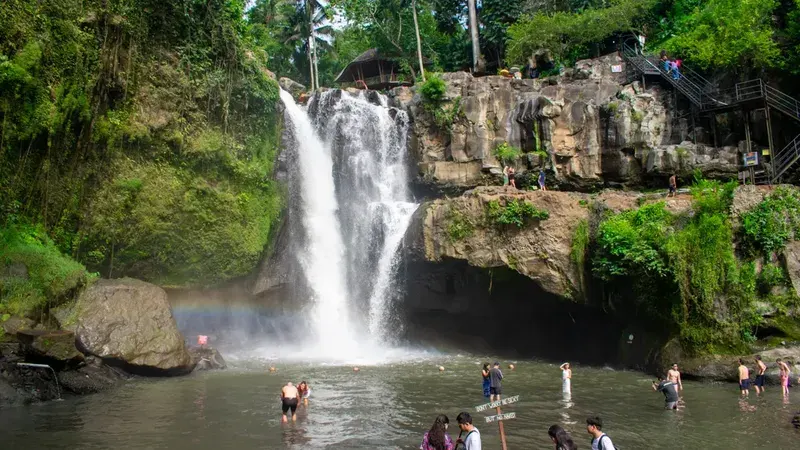
Swimming: Is It Safe, and Can You Jump From the Cliff?
Swimming is allowed in the base pool, and on a hot afternoon it is the main reason people make the trip. The current runs strong close to the waterfall itself, so stay inside the designated, buoyed swimming area rather than drifting toward the falling water, and go in only if you are a confident swimmer. Cliff jumping is not recommended here: the rocks people jump from sit at a height where the pool below is not deep enough to land safely, so treat any jump spot you see locals using with caution rather than as an invitation.
Best Time to Visit: Hour by Hour
Opening, 6:30 to 8 AM
This is the quiet window. The gate has just opened, the tour buses haven't arrived from south Bali yet, and the light comes in low and warm, catching a golden tone around 7 AM most mornings, best for a photo of the full cascade. Water clarity tends to be at its best here too, before an overnight rain upstream has had time to cloud the flow.
Mid-Morning, 8 to 11 AM
This is when day-trip buses and group tours start arriving in numbers, and both the stairway and the pool fill in. If you're set on a specific angle for a photo, expect to wait or share the frame with other visitors.
Midday, 11 AM to 2 PM
The busiest stretch of the day. The lot fills, the stairway carries the heaviest two-way traffic, and the swing line runs longest. Midday sun also flattens the light for photos, so this window suits swimming better than shooting.
Late Afternoon, 2 to 6:30 PM
Crowds thin out from about 3 PM as day-tour groups move on to their next stop, and by 5 PM the site is close to its morning quiet again, with softer light returning as the sun drops. The gate closes at 6:30 PM, so plan to be back at the top of the stairs with time to spare rather than rushing the climb in fading light.
Dry Season vs. Rainy Season
Dry Season, April to October
Dry season gives the clearest water and the least slippery stairs, the closest thing to guaranteed good conditions for swimming and photography. July and August, within this stretch, are also the busiest months of the year, so the clearest water tends to coincide with the biggest crowds.
Rainy Season, November to March
Overnight rain upstream on the Petanu River can turn the water brown and raise the flow by morning, and the stairs pick up a slicker film that makes grippy footwear worth the extra thought. The waterfall itself runs more dramatic at higher flow, and February and March, inside this season, tend to be the quietest months of the year to visit, if muddier water is an acceptable trade for empty stairs.
Beji Temple, the Bird's Nest Viewpoint and Nearby Restaurants
Beji Temple and the Bird's Nest Viewpoint
Beji Temple sits by the river close to the falls, with a holy spring beside it that locals use for prayer and quiet meditation rather than tourist photos, so keep voices down if you pass through. Above the main viewing area, a bird's-nest-shaped photo structure gives a wide angle over the full cascade and the pool below, popular with visitors who want the whole waterfall in one frame rather than a close-up from the base.
How to Behave at Beji Temple
Beji functions as an active place of prayer, not a photo backdrop, so keep a respectful distance from anyone praying or making an offering, and don't step over or on any offerings left on the ground. Casual visitors don't need a sarong just to pass the outer area on the way to the falls, but if you plan to enter the temple itself, cover your shoulders and knees the way you would at any Balinese temple.
Restaurants and Cafes at Tegenungan
Two restaurants overlook the falls from the top of the site: OMMA Day Club and D'Tukad River Club, both set up with views down into the gorge, useful for a coffee or a meal before or after the stairs rather than a quick snack stand at the gate.
Photography Tips
Shoot from the upper viewing platform for the widest angle on the falls, then head down for a base-level shot with the pool and the swing in frame. Morning light before 7:30 AM sits at a low, warm angle that avoids the flat overhead glare of midday, and the bird's-nest viewpoint gives a clean composition without other visitors crowding the edges of the shot.
A Realistic Morning at Tegenungan
From Parking Lot to Pool
The sequence rarely changes: pay at the gate, take the roughly 5-minute stairway down, stop at the viewing platform partway for the wide shot, then reach the pool. Most of a visit's time gets spent at the bottom rather than on the stairs themselves, so budget the walk down as a small fraction of the morning and the pool time as the main event.
A Sample Timeline
This is how a straightforward early visit tends to break down for a visitor arriving close to opening. Push the middle block later and expect the viewing platforms to fill from about half past nine, with the pool busiest between eleven and two.
| Time | What's Happening |
|---|---|
| 6:30 AM | Arrive, pay the IDR 20,000 entrance fee, change if needed |
| 6:35 AM | Walk down the stairs, about 5 minutes, stopping at the viewing platform |
| 6:40 AM | Reach the pool; photos, a swim, or a swing turn (about 9 AM once the operator is on site) |
| 7:30–8:00 AM | Head back up; the climb runs longer than the descent |
| 8:00–8:30 AM | Coffee or breakfast at OMMA Day Club or D'Tukad River Club |
Tegenungan vs. Kanto Lampo, Tukad Cepung and Tibumana
How the Four Waterfalls Compare
Each of Ubud's four main waterfalls has its own character, and picking between them comes down to what you want out of the visit.
| Waterfall | Character | Best For |
|---|---|---|
| Tegenungan | Wide curtain fall, big swimmable pool | Swimming, the rope swing, easiest access |
| Kanto Lampo | Tiered rock-step cascade | Photography on the ledges, shallow wading |
| Tukad Cepung | Cave waterfall with a light-beam shaft | The single most dramatic sight of the four |
| Tibumana | Calmer single curtain into a swim pool | A quieter alternative to Tegenungan |
Which Waterfalls Pair Well in One Day
Tegenungan pairs naturally with Tibumana and Tukad Cepung in a single morning, the itinerary most private drivers run: Tegenungan first for the swim, Tibumana about 30 minutes further on for a quieter pool, then Tukad Cepung another 20 minutes beyond that for the cave and its light beam, timed to arrive before midday closes the window for that shaft of light. Adding Kanto Lampo to the same day is more of a stretch: it sits in a different direction, and folding a fourth waterfall into one morning usually means arriving at each stop later and running into bigger crowds than the three-waterfall route above. If Kanto Lampo is a priority, treat it as its own half day paired with the Monkey Forest or Ubud Palace rather than bolting it onto the Tegenungan run.
Visiting Independently or With a Guide
Touring Independently vs. With a Guide
Tegenungan needs no guide to reach: the parking lot is paved, the entrance is clearly signed, and the stairs down are well maintained, so a scooter or a taxi gets you there without trouble. A guided day earns its keep once you want more than one stop, since a driver who knows guided waterfall days from Ubud can string Tegenungan together with Kanto Lampo, Tukad Cepung and Tibumana, or with the rice terraces and a temple, without you working out routes and parking between each site. The Tegenungan, Tibumana and Tukad Cepung private tour is built around exactly that, three waterfalls in one day with a driver handling the roads between them.
Is Tegenungan Waterfall Worth Visiting?
Yes, and it is the waterfall we point first-time visitors to. It is the easiest of Ubud's cascades to reach, the only one with a real swimming pool at this scale, and the rope swing gives it a reason to stay an hour rather than take a quick photo and leave. If your time near Ubud is short and you can only fit in one waterfall, this is the one.
If you have more than a morning, pair it with Tukad Cepung for the cave and Tibumana for a quieter swim.
Where Is Tegenungan Waterfall?
Tegenungan Waterfall sits in Kemenuh village, Gianyar Regency, at approximately 8°34'30.8"S, 115°17'26.5"E.
Tegenungan Waterfall: Frequently Asked Questions
Is Tegenungan Waterfall worth visiting?
Yes. It is the easiest waterfall near Ubud to reach, the only one at this scale with a proper swimming pool, and the rope swing gives visitors a reason to stay beyond a quick photo stop.
What is the most beautiful waterfall in Bali?
That depends on what you are after. Tegenungan wins on scale and swimming, Tukad Cepung on drama with its cave light shaft, and Kanto Lampo on photogenic tiered rock. Among Ubud's four main waterfalls, Tegenungan is the one most visitors see first and remember longest for the size of the pool.
How many stairs does Tegenungan Waterfall have?
Sources disagree on the exact count, with figures ranging from around 127 to 168. The safest description is about 150 to 170 stairs down through jungle, roughly a 5-minute walk each way.
Is Tegenungan Waterfall the same as Blangsinga Waterfall?
Yes. Blangsinga and Tegenungan are two local names for the same waterfall, named for villages on opposite banks of the Petanu River. It is not a second site to visit separately.
Is there an ATM near Tegenungan Waterfall?
No, there is no ATM on site. A money changer operates just before the entrance ticket booth, so exchange currency there if you arrive without enough rupiah for the entrance fee.
Is there a changing room at Tegenungan Waterfall?
Yes, a small changing room sits to the left of the entrance, useful if you plan to swim in the pool and want to change out of wet clothes before the drive back.
How much does the Tegenungan Waterfall swing cost?
About IDR 200,000, roughly 13 dollars, for a single ride. The swing typically operates from around 9:00 AM to 6:00 PM and runs as a separate charge from the waterfall entrance fee.
Do you need hiking experience to visit Tegenungan Waterfall?
No. The path down is a maintained stone stairway, not a trail, and anyone in average health can manage the roughly 150 to 170 steps. The climb back up is the part people underestimate, since it runs steeper than the way down.
Can you jump from the cliff at Tegenungan Waterfall?
We do not recommend it. Some visitors jump from rocks near the falls, but the pool below is not deep enough at that point to land safely, whatever the current crowd is doing.
How does Tegenungan Waterfall compare to Kanto Lampo, Tukad Cepung and Tibumana?
Tegenungan is the biggest and easiest to swim in. Kanto Lampo is a tiered rock cascade built for photos rather than swimming. Tukad Cepung is a cave waterfall with a shaft of light through the ceiling, the most dramatic of the four. Tibumana is a calmer single curtain into a swim pool, a quieter alternative to Tegenungan for the same kind of dip.
Tegenungan rewards an early start more than any other planning choice you make around it. Get there for opening, swim while the pool is still quiet, and you will be back at the car before the day-trip buses fill the lot. Everyone who has stood at the top of those stairs at 6:45 AM with the falls to themselves understands why this waterfall, not one of the quieter three, is the one that keeps people coming back to Ubud.