Leke Leke Waterfall: The Complete Guide from Ubud

Leke Leke Waterfall is a tall, narrow single drop of about 30 meters pouring into a shallow jungle pool in Tabanan Regency, roughly an hour from Ubud. It sits near Bedugul and the Jatiluwih rice terraces, far from the busy falls around Gianyar, and the entry fee is IDR 50,000 per person. This page covers the walk, the costs, the drive times and the tours, and it is part of our guide to guided Bali waterfall tours from Ubud.
Quick answer
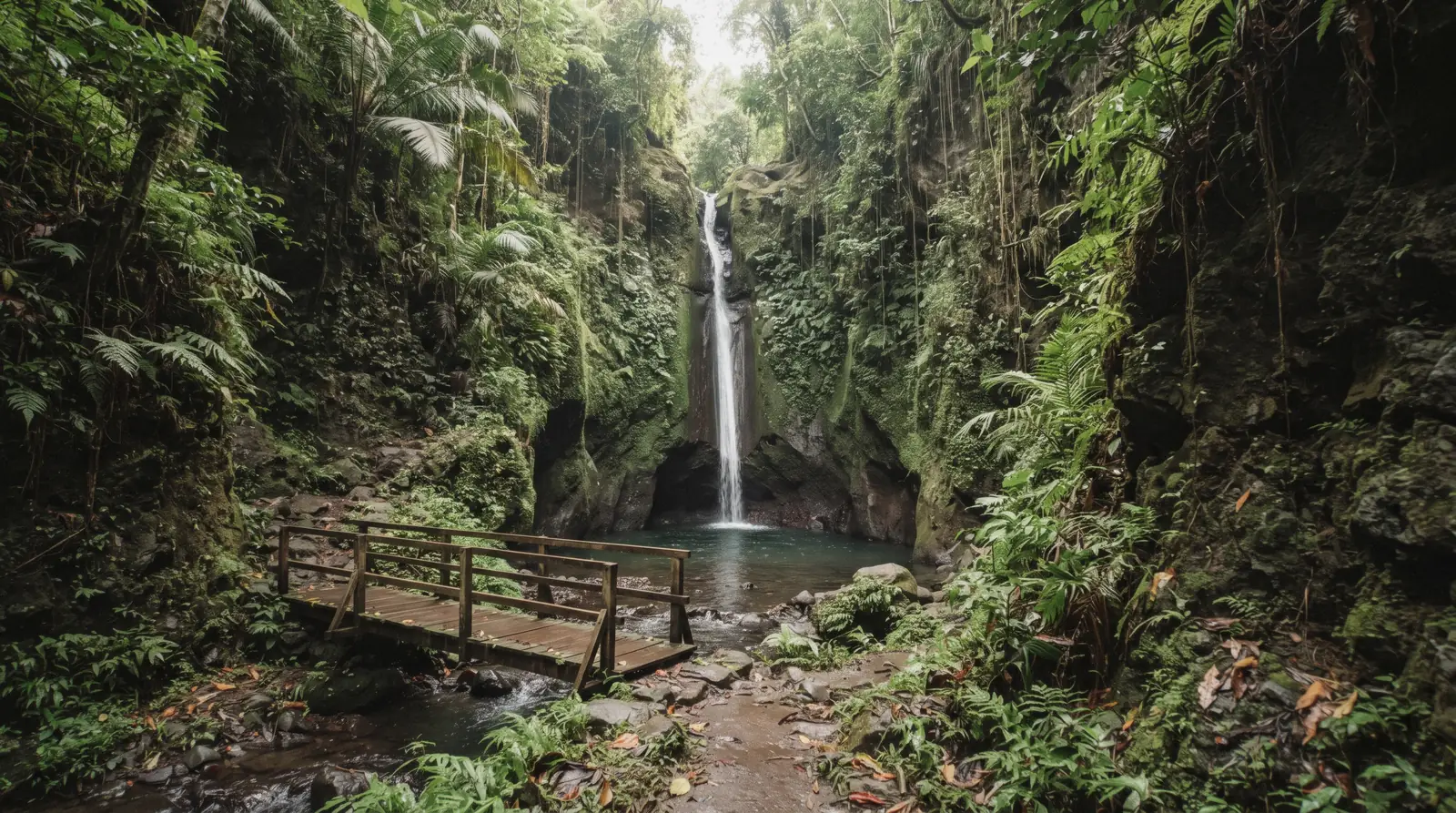
Leke Leke Waterfall charges an entrance fee of IDR 50,000 per person for adults and children, payable in cash or by card at the booth, and opens daily from 7:00 AM to about 6:00 PM with last entry around 5:00 PM. The walk from the ticket counter to the base is roughly 400 steps and takes 15-20 minutes downhill, crossing a bamboo bridge partway. The pool is shallow, so most people wade rather than swim. Arrive before 11:00 AM for the quietest gorge and the best photo light. From Ubud the drive takes about 1 to 1.5 hours, from Seminyak or Canggu roughly 1.5 to 2 hours.
Key takeaways
- Entrance fee is 50,000 IDR per person, cash or card at the booth, no online tickets
- Open 7:00 AM to 6:00 PM daily, last entry around 5:00 PM
- About 400 steps down, 15-20 minutes, with a bamboo bridge partway
- Wading only, the pool is knee-deep in dry season
- Pair it with Jatiluwih or book one of the guided Bali waterfall tours from Ubud
- Best light and fewest people before 11:00 AM
Visiting With a Tour or on Your Own
Leke Leke is one of the easier Bali waterfalls to reach independently if you have a scooter and steady legs on wet roads, but it sits in Tabanan, a long way from the Gianyar cluster, so many visitors let a driver handle the mountain roads. A tour earns its fee when you want two or three stops in one day without negotiating parking, tickets and timing yourself. The Bali: Leke-Leke, Nungnung, Goa Gong & Jatiluwih Tour links the falls with the Jatiluwih terraces in 8 hours with pickup included. The Bali: Leke-Leke Waterfall, Monkey Forest & Jungle Swing Tour runs 10 hours and folds Leke Leke into a day with Ubud's Monkey Forest and a rice-terrace swing. Both start from $34 and include pickup, which is close to what a private driver costs anyway.
 from $34
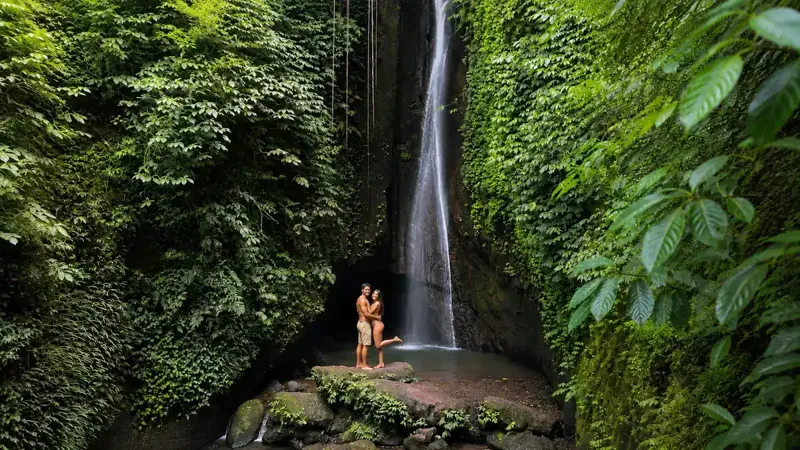
Bali: Leke-Leke, Nungnung, Goa Gong & Jatiluwih Tour
Two of the big falls north of Ubud in one private day: the long stair descent to Nungnung, the cave-like Goa Gong, the Leke Leke gorge, then the…
- Nungnung, down the long stairway to the base
- Goa Gong, a waterfall inside a rock hollow
- Leke Leke in its jungle gorge
- Jatiluwih rice terraces
 from $34
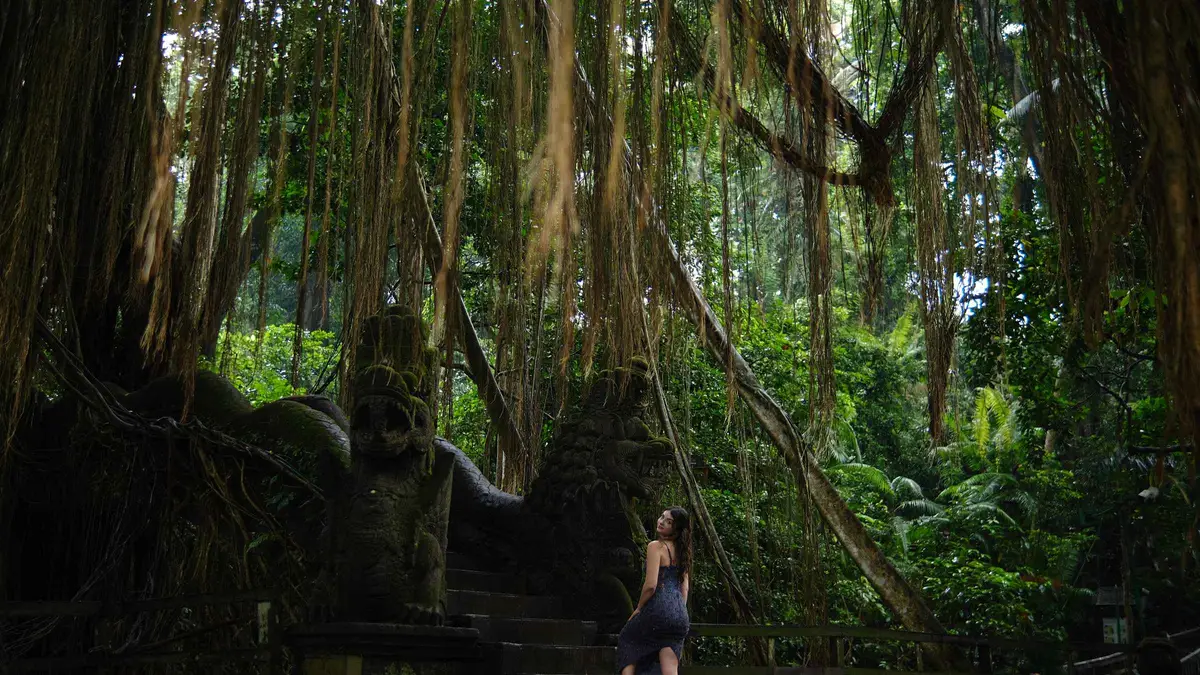
Bali: Leke-Leke Waterfall, Monkey Forest & Jungle Swing Tour
Leke Leke in the Tabanan forest first, then back towards Ubud for the Sacred Monkey Forest and a jungle swing over the rice terraces. A long day that…
- Leke Leke waterfall on a short forest trail
- Ubud's Sacred Monkey Forest
- Jungle swing over the rice terraces
- Pickup, private option available
What Leke Leke Waterfall Is and Why People Go
A Single Drop in a Green Gorge
Leke Leke is a single-drop waterfall of around 30 meters, falling in one narrow white curtain between rock walls draped in moss and ferns. The water lands in a wide but shallow pool, and the whole gorge feels enclosed, green and quiet compared with the open river valleys around Ubud. Because the drop is tall and thin rather than wide, photographs from the viewing rock in front of the pool work well at almost any hour. It is the kind of waterfall you reach by walking down into it, not by looking at it from a car park, which is a large part of its appeal.
The height is reported differently across guides, from about 30 meters to about 32 meters, so treat 30 meters as a fair round figure. One source even lists it as low as 15 meters, but the 30-32 meter range has better support. Either way, it reads as a full-height fall from the base.
Quieter Than the Ubud Cluster
The waterfalls most Ubud visitors see, such as Tegenungan, Tibumana, Kanto Lampo and Tukad Cepung, all sit within an hour of town in Gianyar. Leke Leke sits in the opposite direction, in central Bali near Bedugul, so it draws a fraction of the tour-bus traffic. Even at midday you can often find space at the base, and before 11:00 AM the gorge can be close to empty.
It is also an easier walk than several of its rivals. There are steps, but they are small, even and mostly shaded, which makes it a sensible first jungle waterfall for families or anyone unsure about their fitness. If your plan is one waterfall day from Ubud and you want jungle rather than crowds, this is the one worth the longer drive.
Why It Sits Outside the Ubud Circuit
Leke Leke belongs to a different geography from the falls on our other pages. Tegenungan, Tibumana, Kanto Lampo and Tukad Cepung line the rivers of Gianyar Regency, southeast of Ubud, and most operators chain two or three of them in a half day. Leke Leke stands in Tabanan Regency on the road toward Bedugul, in the cool highlands that also hold the Jatiluwih rice terraces and Lake Beratan.
That distance changes how you plan the day. A Leke Leke trip is not a quick morning out from Ubud. It is a full-day outing into central Bali, best combined with terraces, a temple or a second waterfall such as Nungnung. Once you accept the drive, you get waterfalls and highland scenery that look nothing like the south coast, which is exactly why guides keep recommending it.
Quick Facts Overview
The Essentials at a Glance
Before you commit a day to the road, here are the core numbers. The entrance fee is 50,000 IDR per person and applies equally to adults and children, with cash and card both accepted at the ticket booth and no online ticket option. Opening hours run 7:00 AM to 6:00 PM daily, with last entry around 5:00 PM, though one guide lists a 5:00 PM close instead, so aim to arrive well before that. Parking is free and sits right beside the ticket office.
The waterfall stands about 30 meters tall. The descent is roughly 400 steps taking 15-20 minutes down. Swimming is limited to wading, since the pool is typically knee-deep. The best photo window is before 11:00 AM, and facilities mean toilets at the top only, so plan around that before you start the stairs. Fahey James Travel and Bali Holiday Secrets both give the 50,000 IDR fee.
How to Read the Numbers
A few of these figures vary between sources, and it is more useful to know the range than a single confident number. The closing time is listed as 6:00 PM by two guides and 5:00 PM by one, so we print 6:00 PM as the primary figure and note the difference. The height ranges from about 30 to 32 meters. Drive times from the south vary the most, because Bali traffic makes every estimate soft.
What does not vary is the fee: 50,000 IDR per person at the booth. That figure is confirmed independently by every usable source we checked. When you budget the day, add the entry, a little cash for the swing if you want it, at roughly 200,000-250,000 IDR depending on the swing type, and food at one of the two on-site restaurants.
Where Leke Leke Waterfall Is
The Village and the Regency
Leke Leke Waterfall sits in the village of Kerobokan in the district of Mekarsari, Baturiti, Tabanan Regency, in central Bali. That address confuses people, because there is another, far better-known Kerobokan near Seminyak and Canggu on the south coast. They are not the same place. If you type Kerobokan into a maps app from the south, you will end up an hour and a half in the wrong direction.
Search instead for Leke Leke Waterfall by name, or use the plus code J5MX+68 Mekarsari, Tabanan Regency. The falls lie just off the main road heading north toward Bedugul, which makes them an easy first or last stop on any highlands route. Tabanan is farming country, so expect the drive itself to pass rice fields and clove trees long before you see water.
Position Relative to Bedugul and Jatiluwih
Geographically, Leke Leke belongs to the Bedugul highlands circuit rather than the Ubud waterfall cluster. The Jatiluwih rice terraces, a UNESCO-listed landscape, lie about 8 km away, a drive of roughly 30-45 minutes on winding village roads. Ulun Danu Beratan Temple on the lake sits about 14 km north, around 30 minutes further toward Bedugul.
That positioning is the practical reason to come here. You can leave Ubud mid-morning, walk to the falls before the lunchtime crowd, eat at one of the on-site restaurants, then continue to Jatiluwih or the lake in the cooler afternoon. Independent drivers do this loop all the time. The map below shows the pin so you can see at a glance how far north and west of Ubud you will be travelling.
Entrance Fee, Opening Hours and Parking
What You Pay at the Booth
Entry to Leke Leke Waterfall costs 50,000 IDR per person. The fee applies to adults and children alike, so a family of four pays 200,000 IDR total. The ticket booth accepts both cash and card, which is unusual for a rural Bali attraction, though carrying some cash is still wise for parking-adjacent snacks, the swing or tips. There is no online ticketing, no reservation and no queue system. You arrive, you pay, you walk.
For context, this is mid-range for Bali. Some community-managed falls charge less, and the big named falls charge similar or more. The fee covers maintenance of the steps and bridge, and it also covers the photo nest near the entrance, which costs nothing extra once you are in.
Opening Hours and Last Entry
The gates open at 7:00 AM every day of the week, which makes an early start genuinely possible and is the single best reason to come from Ubud before the tour vans. Most sources list closing at 6:00 PM, with last entry around 5:00 PM. One guide instead gives a 5:00 PM closing time, and sources differ on this point. In practice, treat late afternoon as uncertain and plan to be back at the top well before 5:00 PM.
The hours matter most in combination with the walk. Give yourself a relaxed stretch of time on site to descend, enjoy the pool, climb back and eat. In the rainy season the light fades early under the trees, so there is little reason to arrive after 3:00 PM.
Parking at the Top
Parking is free and located directly beside the ticket office, a few steps from the start of the trail. That is simpler than many Bali attractions, where scooter parking carries a small fee and car parking means a voluntary donation box and an attendant with a notebook. Here you pull in, leave the vehicle and start walking.
The lot is small, so on busy weekends around lunchtime, between roughly noon and 3:00 PM, it can fill. Arriving before 11:00 AM solves that problem the same way it solves the crowds on the stairs. If you come with a private driver, the driver waits in the lot at no charge, which is one more reason tours and hired cars work well for a Tabanan day.
Getting There: From Ubud, the South and Jatiluwih
From Ubud
The drive from Ubud to Leke Leke takes about 1 to 1.5 hours, and sources differ on the exact figure. Two guides put it at roughly an hour, one of them measuring about 30 km, while a third allows an hour and a half. The truth depends on traffic through the villages west of Ubud and on road works, which come and go. Budget 1.5 hours and you will never be late.
The route runs west and then north through Tabanan farmland, climbing steadily as you approach Baturiti. Scooters make the trip in the same time but the final stretch is highland road, cool and occasionally misty, so bring a layer. A private car with driver is the comfortable choice, and both tours on this page include pickup from Ubud hotels.
From Seminyak, Canggu and the Southwest Coast
From Seminyak or Canggu the drive is roughly 1.5 to 2 hours, and again sources differ. Two guides give 1-1.5 hours, around 38-41 km, while a third says closer to 2 hours and advises doubling whatever Google Maps estimates because of Bali traffic. Our advice is to believe the cautious figure. Leaving the coastal strip at 7:00 AM can save you 30 minutes on its own.
The route climbs through Tabanan's interior, and the last half hour is genuinely mountain driving. If you are self-riding from Canggu, fill the tank before you leave the coastal road, because stations thin out north of the main highway. From Kuta the trip runs about 1.5-1.75 hours, about 46 km, and from Sanur about 1.5 hours over roughly 43 km.
From Uluwatu, Nusa Dua and Jatiluwih
From the far south the day gets long, so start early or reorganise. From Uluwatu the drive is about 2-2.5 hours, with sources differing, and the distance is around 70 km. Nusa Dua sits about 58 km away, close to 2 hours. Jimbaran sits in the same approximate 2-hour band. None of these are comfortable day trips with a waterfall walk in the middle unless you leave by 7:00 AM.
Coming from the other direction, the Jatiluwih rice terraces lie about 8 km from the falls, roughly 30-45 minutes on small roads. Many travellers do the pair in one afternoon: terraces first while the light is flat, then the waterfall when the gorge is shaded. If you are already staying near Bedugul, Leke Leke is a short hop rather than an expedition, which is why some visitors base themselves in the highlands instead of the coast.
The Walk Down: Steps, Bamboo Bridge and Difficulty
Roughly 400 Steps to the Base
From the ticket counter, the trail to the base drops roughly 400 steps. The steps are small and evenly spaced, cut into the hillside and shaded by jungle the whole way, and they are not steep by Bali standards. The walk down takes about 15-20 minutes at a normal pace, though some visitors report 25-30 minutes when stopping for photos, which is understandable because the gorge views start almost immediately.
Overall the trail is counted at about 800 steps return, since everything you descend you must climb back. That return climb is the part people remember. It is not dangerous, but after a swim and in midday heat, 400 uphill steps will raise your pulse. Drink water at the top, take the descent slowly and save some energy for the way out.
The Bamboo Bridge and the Muddy Sections
Partway down, the path crosses a bamboo bridge about 15 meters long, built over a stream channel. The bridge is sturdy and adds the best photo moment of the walk, with jungle closing in on both sides. Sections of path just before and after the bridge can be muddy or slippery, especially after rain, so watch your footing rather than your phone there.
After the bridge there is a further walk of about 5 minutes to reach the waterfall itself, following the stream into the narrowing gorge. This last stretch is where proper shoes matter most, because the stone can stay damp all day in the shade. The difficulty overall sits well below the staircases at Tukad Cepung or the long descent at Nungnung, and most reasonably fit visitors, including children, manage it comfortably.
How Hard Is It Really?
Honest answer: the way down is easy, the way up is work. Guides describe this as an easier walk than the stairs at Tukad Cepung or the slope at Tibumana, and the steady, even steps are a big reason why. There are handrails on the exposed sections, and the shade keeps the temperature several degrees below the road above.
Plan the climb back for a moment when you are not rushed. Most people take a rest at the halfway restaurant, which sits about 100 steps down from the top, and that break makes the remaining climb trivial. Anyone with knee problems should consider a walking stick. Elderly visitors who walk regularly complete it, but if stairs are a struggle at home, this is a fair question to ask before committing, and the FAQ below covers it in more detail.
Is Leke Leke Waterfall Closed?
Open and Operating
Yes, Leke Leke Waterfall is open. Online rumours about closures circulate periodically, as they do around many Indonesian waterfalls, and one well-read travel guide explicitly set out fearing the falls would be shut and found them alive and well. There is no current closure. The ticket booth, the steps, the bamboo bridge and the on-site restaurants all operate daily within the 7:00 AM to 6:00 PM hours.
Where do the rumours come from? Usually from temporary events rather than permanent ones: heavy rain in the rainy season can raise the stream and make the path briefly unsafe, and village ceremony days occasionally alter access for a few hours. Neither amounts to a closure of the attraction. If you read a recent claim that it is closed, check the date on it, because most of these reports age badly.
What Would Actually Close It
The realistic causes of an unplanned closure are weather, not administration. Extended rain between November and March can swell the stream, turn the dirt path sections to mud and occasionally prompt the village to restrict entry for safety. These stoppages last days, not seasons. The rest of the year the falls run on their normal schedule without interruption.
If you want certainty on the morning of your visit, your driver or tour operator will know. Guides working the Tabanan route pass the entrance regularly and hear about any disruption immediately. That is a quiet advantage of booking a guided day rather than driving out blind. For everyone else, the practical rule is simple: after a night of very heavy rain, phone ahead or shift your waterfall day rather than assuming the trail is in normal condition.
Can You Swim at Leke Leke Waterfall?
Wading, Not Swimming
No, you cannot really swim at Leke Leke, and knowing this in advance saves disappointment. The pool at the base is wide but shallow. In the dry season it typically sits knee-deep, and even in the rainy season only a few spots reach waist height. The water is cold and clean and very welcome after the climb down, but nobody is swimming laps here.
What people actually do is wade in to the shins or knees, stand under the mist coming off the drop and take photos against the falls. That is the experience, and it is a good one. Wear shorts or a swimsuit under your clothes, bring a small towel, and expect to be pleasantly refreshed rather than soaked. If a deep swimming hole is your priority, Tibumana or Tegenungan near Ubud will serve you better.
Best Time to Visit
Arrive Before 11:00 AM
The best window at Leke Leke is early morning, before about 11:00 AM. Two things improve together in that window: crowd levels and photo light. In the morning the sun sits above the gorge, the falling water is evenly lit, and the pool's surface shows the full drop. By early afternoon the falls fall into shadow and the contrast in photographs gets harder to manage.
Crowds follow the tour buses, which arrive around lunchtime and stay until about 3:00 PM. Visit before 11:00 AM and you can genuinely have the gorge nearly to yourself, which is the version of this waterfall worth the early alarm. Since the gates open at 7:00 AM, a 7:30 or 8:00 arrival from Ubud or the highlands is entirely realistic, and the drive back to Ubud afterwards beats the afternoon traffic.
Dry Season Versus Rainy Season
Season changes the character of the visit. In the dry season, roughly April to October, the trail is firm, the pool stays knee-deep and the steps dry quickly after dawn. In the rainy season, roughly November to March, the waterfall runs heavier and more dramatic, but sections of the stone and dirt path become slippery after rain, and the shallow pool can rise toward waist depth in places.
The rainy season does not mean you should stay away. It means grippy closed shoes instead of flip-flops, a slower pace on the bridge and the shaded stone, and a flexible attitude if a downpour is falling when you wake up. Locals walk this trail in every month of the year. Dress for it and the green season delivers the most powerful version of the falls you will see.
What to Wear and Bring
Shoes First
Shoes are the decision that shapes the whole visit. Wear grippy, closed shoes with a real sole: trail runners, trainers with tread, or proper sandals with straps and grip. Skip smooth flip-flops entirely, and especially avoid them if it rained recently, because the stone steps and the dirt sections near the bamboo bridge hold moisture in the shade all day. Guides see more minor slips from bad footwear than from any other cause on this trail.
The steps themselves are even and well maintained, so you do not need hiking boots. What you need is traction on damp stone. If you are combining Leke Leke with a second waterfall in the same day, as most tours do, keep the same shoes on for both. Dry socks in the car for the drive home are a small luxury that earns its place in the bag.
The Rest of the Day Pack
Beyond shoes, pack light and practical. Bring swimwear if you want to wade, since the pool is shallow but cold and you will want to get in at least to the knees. Carry water and a few snacks, because the climb back up after a swim is the moment people run low. A small towel, a dry bag or a ziplock for your phone, and sunscreen for the open sections at the top round out the list.
Cash helps even though the ticket booth takes cards: the swing, warung snacks and small tips all move faster with rupiah in small notes. Leave valuables in the car rather than carrying them down the steps. If you are visiting between November and March, add a light rain shell. Everything else you might need, including toilets and two restaurants, waits for you at the top.
The Swing and the Jungle Photo Nest
The Swing Over the Valley
Near the waterfall area there is a jungle swing of the style Bali has become known for, and it is a popular add-on once you are on site. Pricing depends on the swing and sources differ: one guide lists a single swing at 200,000 IDR and a bed swing, for small groups, at 250,000 IDR, with insurance and a rental dress included, while another gives a flat figure of 250,000 IDR. Presenting it fairly, expect roughly 200,000-250,000 IDR depending on the swing type.
The rental dress matters if you want the classic flowing-photos-over-the-forest shot, because the included dress is what makes those pictures. If you book the Leke-Leke, Monkey Forest & Jungle Swing tour, a rice-terrace swing later in the day is already in the itinerary, so you can ride here for photos and save the second swing for Ubud, or skip one of the two.
The Photo Nest by the Entrance
Near the entrance and the warung area there is a woven photo nest, the raised bamboo platform you have probably seen in Bali Instagram posts, set against the jungle canopy. It costs nothing extra. The nest is included in your entrance fee, so once you have paid the 50,000 IDR at the booth, the attendant will point you to it and there is no additional charge or ticket.
Timing matters more than money here. The nest faces open jungle, so morning light flatters it, and before 11:00 AM you are unlikely to queue. Later in the day, between lunchtime and 3:00 PM, a short line forms and each group gets a few minutes. Do the nest either before your walk down or straight after the climb back up, while the light and your patience are both still good.
Food Near Leke Leke Waterfall
Two Restaurants on Site
You will not go hungry at Leke Leke. There are two small restaurants on the site itself. The first sits right after the ticket counter, with a terrace looking out over the jungle canopy, and it is the natural stop either before the descent or during the climb back up. The second sits about 100 steps down, near the swing area, with a more limited menu. Both serve mid-range Western and Indonesian food: burgers, pizza, fries and local dishes such as nasi goreng and mie goreng.
Prices sit at casual-tourist levels rather than local-warung levels, which is the trade for eating 400 steps from the nearest road. A warung near the entrance also sells snacks and drinks if you only want a coconut after the walk. Bring a little cash anyway, since card payments at the smaller spots cannot always be counted on.
Eating Beyond the Entrance
If you would rather eat away from the attraction, the surrounding area supports the Bedugul and Jatiluwih circuit, so simple restaurants and warungs line the routes toward both. The village road toward Baturiti has local eateries serving the Tabanan standards, and the road toward Jatiluwih passes several places that exist mainly to feed terrace visitors at lunch.
Our honest advice is to eat at the falls themselves and plan your proper meal stop around the rest of the day. Have lunch at the upper restaurant after your morning walk, then continue to Jatiluwih or Ulun Danu Beratan and eat again or snack there. On a tour day this is all handled for you, since the driver builds a meal stop into the route and knows which kitchens are open at the hour you arrive.
What Is Nearby: Jatiluwih, Ulun Danu Beratan, Banyumala and Nungnung
Jatiluwih and Ulun Danu Beratan
The two natural partners for a Leke Leke day are both highland icons. The Jatiluwih rice terraces, a UNESCO-listed cultural landscape, lie about 8 km away, a drive of roughly 30-45 minutes through village roads. The terraces are at their best in soft light, which makes them a perfect afternoon follow-up to a morning waterfall walk. Combine the two and you get Bali's greenest waterfall and its most famous farmland in one loop.
Ulun Danu Beratan Temple sits about 14 km north, roughly 30 minutes further toward Bedugul, floating on the lake in the classic postcard image. It works well as a final stop, since the temple grounds are pleasant in the late afternoon mist. The drive between all three points is cool and scenic, a genuine contrast with the coastal roads, and it is the route both local drivers and the Leke-Leke, Nungnung, Goa Gong & Jatiluwih tour follow.
Banyumala and Nungnung
Two more waterfalls sit within striking distance. Banyumala Twin Waterfall lies about 28 km away, around an hour's drive, deeper toward the northern slopes, and rewards the journey with twin curtains falling into a natural shallow pool you can actually swim in. It is a rougher road and a steeper trail, so it suits a second visit rather than a first.
Closer and easier to justify is Nungnung Waterfall, widely recommended as a second stop on the same day and described by visitors as a much bigger waterfall than Leke Leke. It demands its own long stairway, so doing both in one morning is a workout, but the contrast is excellent: the tall narrow drop, then the wide thundering one. The Leke-Leke, Nungnung, Goa Gong & Jatiluwih tour builds exactly this pairing into a single 8-hour day with the driving handled for you.
Angseri Hot Springs
One more local option deserves a mention, especially for anyone whose legs are negotiating the terms of the climb back up. Angseri Hot Springs, a short drive from the falls, offers natural hot pools set in the Tabanan countryside where you can soak tired muscles for a modest fee. It is a quiet, low-key place, far less developed than the spa complexes in the south, and locals use it as much as tourists.
The logic of the stop is simple: a cold waterfall in the morning, a hot spring in the late afternoon, and the drive home is far more pleasant for everyone in the car. It also gives the day an extra hour of value at very little cost in driving time, since Angseri sits along the Tabanan side of the loop. Ask your driver. Almost everyone running this route keeps it in their back pocket for exactly this purpose.
How Leke Leke Compares to the Ubud-Area Waterfalls
Four Different Falls, Four Different Days
Visitors mix up Bali's named waterfalls constantly, so here is the honest sorting. Tegenungan is the wide, powerful, busy one closest to Ubud, with deep water, big crowds and easy access. Kanto Lampo is a tiered fall spilling over a rock face you can climb partway, photogenic and quick to visit. Tibumana is a single curtain into a calm, swimmable pool, the gentlest of the group. Tukad Cepung is a waterfall inside a cave, famous for the midday light beams that hit its wall.
Leke Leke differs from all four in kind, not just degree. It is a tall narrow drop in an enclosed jungle gorge, shallow at the base, and it sits in Tabanan near Bedugul rather than in the Gianyar cluster east of Ubud. It is further, quieter and less touristy than any of the four, and the walk, at roughly 400 small steps, is more involving than Tegenungan's flat approach.
Choosing the Right Waterfall for Your Day
Choose by what your day needs. If you have a free morning in Ubud and want minimum driving, Tegenungan or Kanto Lampo deliver a waterfall fix within 30 minutes. If you want a swim, Tibumana's pool is the pick. If you want the cave photograph, Tukad Cepung works at midday. These four chain together easily, which is why most Ubud waterfall tours cover two or three of them.
Choose Leke Leke when the waterfall is one part of a bigger highland day. It earns its drive when paired with Jatiluwih's terraces, the lake temple or a second fall such as Nungnung, and it rewards you with the quietest gorge of the lot. The table below lines the five falls up side by side so you can see the trade-offs at a glance before you commit a day of holiday to any of them.
Side by Side
Here is how the five waterfalls compare on the figures that matter for planning, using the figures given on their own pages.
| Waterfall | Regency | Character | Swimming | From Ubud |
|---|---|---|---|---|
| Leke Leke | Tabanan | Tall narrow single drop in a jungle gorge | Wading only, knee-deep | About 1-1.5 hours |
| Tegenungan | Gianyar | Wide, powerful and busy | Yes, deep pool | Closest to Ubud |
| Kanto Lampo | Gianyar | Tiered waterfall over a climbable rock face | Shallow | Short drive |
| Tibumana | Gianyar | Single curtain into a calm pool | Yes | Short drive |
| Tukad Cepung | Gianyar | Waterfall in a cave with light beams | Shallow | Short drive |
Visiting Independently or With a Guide
When Independent Works
Leke Leke is straightforward to visit on your own. The entrance is signed off the main Bedugul road, parking is free beside the ticket office, the fee is a flat IDR 50,000 with card accepted, and the trail needs no guide at any point. If you are comfortable on a scooter and confident on damp steps, the whole visit runs itself. The one real cost of independence is logistics: the drive from Ubud is about 1-1.5 hours each way, the mountain section is winding, and building Jatiluwih or a second waterfall into the same day means you are your own route planner.
Independent also means flexible timing. Arrive at 7:30 AM and you will share the gorge with nobody, which no scheduled tour can promise. If you base yourself near Bedugul or Jatiluwih rather than Ubud, the falls become a short hop and independence makes even more sense.
When a Tour Earns Its Fee
A tour earns its money on the driving and the combination. Two options cover Leke Leke well. The Leke-Leke, Nungnung, Goa Gong & Jatiluwih Tour runs 8 hours, costs from $34, holds a rating of 4.9 from 82 reviews and includes pickup, chaining Leke Leke with the big staircase descent at Nungnung, the cave-like Goa Gong and the Jatiluwih terraces. For a first visit to central Bali it is the most complete single day available.
The Leke-Leke Waterfall, Monkey Forest & Jungle Swing Tour runs 10 hours, from $34, rated 4.8 from 211 reviews, also with pickup, and pairs the falls with Ubud's Sacred Monkey Forest and a rice-terrace swing. Choose it if you want one waterfall plus Ubud's classics rather than a highlands loop. Both are private-car days, so the driver handles tickets, parking and timing while you handle the steps.
Booking and Practical Notes
Whichever way you go, book the night before rather than the same morning, especially in high season, because drivers working the Tabanan route fill up early. Tours from this page run through GetYourGuide with free-cancellation windows shown on the booking card, so reserving early costs you nothing if the weather turns. Confirm your pickup time in the chat, since an 8-hour day with a 7:00 AM start is the difference between an empty gorge and a queue.
Budget beyond the tour price for the items it does not include: the entrance fee of 50,000 IDR per person at the gate, lunch at the on-site restaurant, and roughly 200,000-250,000 IDR if you want the swing. Bring cash in small notes for those. Wear the shoes described above, and treat the climb back up as part of the product you are paying for rather than an unpleasant surprise.
Where Is Leke Leke Waterfall?
The pin marks the falls in Mekarsari, Baturiti, in Tabanan Regency, just off the main road toward Bedugul.
Leke Leke Waterfall: Frequently Asked Questions
Is Leke Leke Waterfall worth it?
Yes, if you accept the drive. The fall is a tall single drop of around 30 meters in a quiet gorge, the walk is manageable at roughly 400 small steps, and it draws far fewer visitors than the Ubud-area falls. It delivers the most value when combined with Jatiluwih, Ulun Danu Beratan or Nungnung, so treat it as the anchor of a highlands day rather than a standalone stop.
How long is the walk to Leke Leke Waterfall?
From the ticket counter to the base is roughly 400 steps, about 15-20 minutes downhill, though some visitors take 25-30 minutes with photo stops. The path crosses a bamboo bridge partway, then it is about 5 more minutes to the falls. Plan on the return climb taking longer than the descent.
How much does it cost to enter Leke Leke?
The entrance fee is 50,000 IDR per person, applying to adults and children alike. The ticket booth takes cash or card and there are no online tickets. The photo nest near the entrance is included at no extra charge, while the swing costs roughly 200,000-250,000 IDR depending on the swing type.
Is Leke Leke Waterfall closed?
No. Despite online rumours of closure, the waterfall is open and operating within its normal daily hours of 7:00 AM to about 6:00 PM. Temporary disruptions after very heavy rain in the rainy season are possible but short-lived, so check conditions with your driver after a major storm rather than believing an old closure report.
Can you swim in Leke Leke waterfall?
Not really. The pool is wide but shallow, typically knee-deep in the dry season and up to waist-deep in a few spots during the rainy season. Most visitors wade in briefly for photos and to cool off. If a deep swimming hole is the goal, Tibumana or Tegenungan near Ubud are better choices.
How do I get to Leke Leke Waterfall from Ubud?
The drive from Ubud takes about 1 to 1.5 hours, and sources differ on the exact figure, so allow the longer time. You can ride a scooter, hire a private driver, or book a tour such as the Leke-Leke, Nungnung, Goa Gong & Jatiluwih day, which includes pickup. Search the falls by name rather than the village name Kerobokan, which is easily confused with the Kerobokan near Seminyak.
How many steps are there at Leke Leke Waterfall?
About 400 steps down from the ticket counter to the base, or roughly 800 return. The steps are small, evenly spaced and not steep, which is why the trail is rated easier than Tukad Cepung's stairs or Tibumana's slope. The climb back up is the tiring part, so pace yourself and rest at the restaurant about 100 steps from the top.
What is the best time to visit Leke Leke Waterfall?
Early morning, before about 11:00 AM. You get the fewest people, since most crowds arrive around lunchtime and stay until 3:00 PM, and the best photo light before the falls fall into afternoon shadow. The gates open at 7:00 AM, so a pre-9:00 arrival from Ubud is very doable.
Is Leke Leke Waterfall suitable for kids or elderly visitors?
For school-age children who can manage stairs, yes. The steps are even and shaded, and the shallow pool removes most drowning worry, though supervision at the water is still needed. For elderly visitors it depends on knees and stamina: regular walkers complete the roughly 400-step return trip, but anyone who finds stairs difficult at home should think carefully, and remember there are no toilets at the bottom.
What should I wear to Leke Leke Waterfall?
Grippy closed shoes with a real tread are the priority, because stone and dirt sections get slippery after rain, particularly from November to March. Wear shorts or a swimsuit if you want to wade, and carry water, snacks, a towel and some cash. Leave flip-flops at the hotel and keep a dry set of clothes in the car.
Where do I leave photos of Leke Leke? Is there a photo spot?
There are three classic shots: the falls themselves from the rocks at the base, the bamboo bridge about 15 meters long partway down the trail, and the woven photo nest near the entrance, which is included in the entrance fee at no extra charge. Morning light before 11:00 AM is best for all three, and the jungle swing adds the option of a dressed-up flying-photos session for roughly 200,000-250,000 IDR.
How does Leke Leke compare with the waterfalls near Ubud?
It is taller and quieter than Tegenungan, more of a single dramatic drop than Kanto Lampo's tiered rock face, less swimmable than Tibumana and more open than Tukad Cepung's cave. The real difference is geography: it sits in Tabanan near Bedugul, about 1-1.5 hours from Ubud, so it suits a full highlands day rather than a quick morning trip.